 paddy carver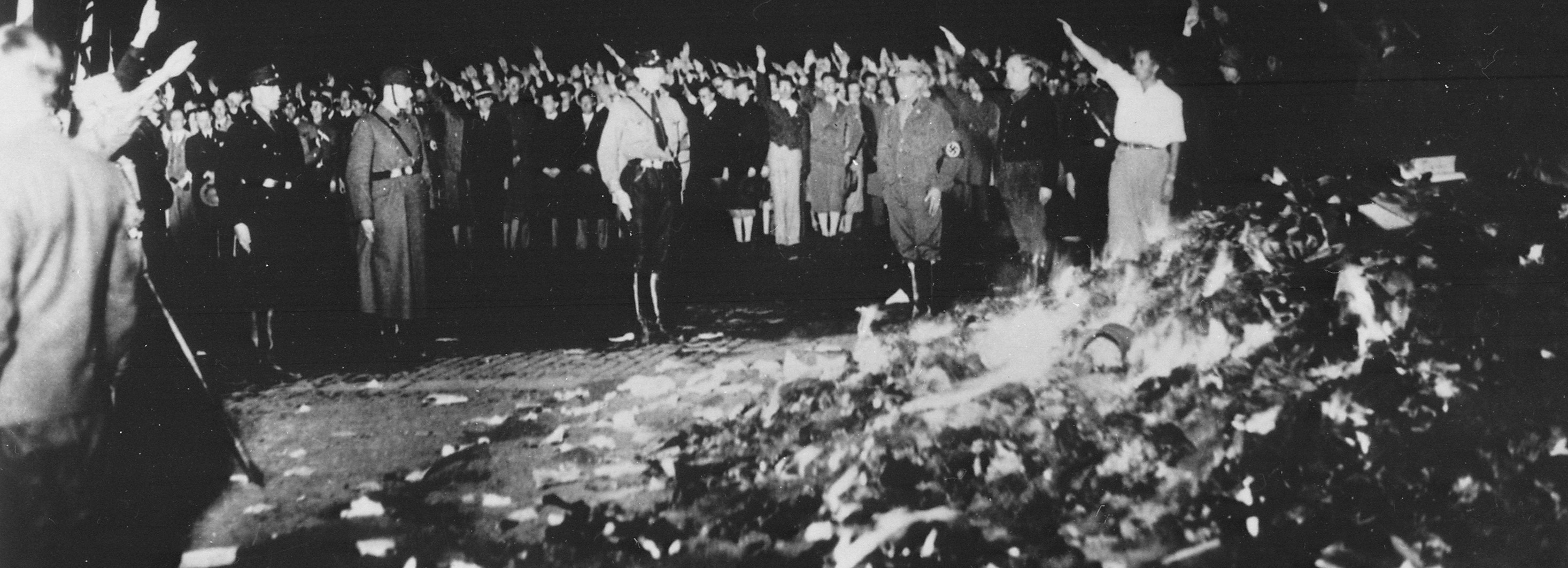

“Soon the day will come when science will win victory over error, justice a victory over injustice, and human love a victory over human hatred and ignorance.”
—Magnus Hirschfeld
Let’s talk a little bit about Nazis today. Because I think people sometimes feel like queer people overstate their fear at recent turns of events, or that the fear is unreasonable or unfounded. So let’s take a look at where we’ve seen some historical parallels to what’s happening, and what happened the last time it happened.
To start with, let’s go back to the late nineteenth century, with this super rad guy named Magnus Hirschfeld. Magnus was an all-around cool guy, and look, you really should just listen to the History is Gay podcast episode about him, because they 1) are much better historians than I am and are way more qualified than I am to talk about this and 2) go into much more detail about this than I’m going to here. Suffice to say, as the understatement of the century, he was a groundbreaking sexologist working in Berlin at the turn of the millennium who tried to tie his work in science to social change. One of his causes was repealing paragraph 175, a German law that prohibited sex between men. At the end of the nineteenth century, he had an uphill battle, and dealt with the same small-minded nonsense we’ve seen elsewhere in history. The conservative right was against the repeal, the more liberal party supported the repeal after some time, and the story is probably familiar to anyone in the states.
The big change, of course, was World War I happening, and a much more liberal government getting installed in the wake of it. They ordered the police to not enforce paragraph 175. This came on the tail of some more strides for queer rights in Berlin, which was a hotbed of queer rights at the end of the nineteenth century. 1896 saw the creation of the first queer magazine. Hirschfeld founded the very first gay rights organization, the Scientific-Humanitarian Committee, in 1897. Berlin also hosted the first queer demonstration in 1922. By 1929, the fight to decriminalize homosexuality in Germany had almost been won, a full 50 years before the Stonewall riots.
And then there were Nazis. The Nazis rose on a wave of racism and anti-Semitism, cloaked in the völkisch movement, which emphasised a return to the “folkish” roots of Germany. For the conservative right, that translated to “like us” and for the liberal left meant “middle class”–again, in a story that will be familiar to anyone in the US.
And, as is the pattern, the right, embodied this time in the Nazi party, immediately began rolling back the social progress achieved in recent years with extreme prejudice, assuaging their perceived sense of deprivation at the hands of marginalised people. And they did so with earth-shattering force.
Hirschfeld had created the Institut für Sexualwissenschaft (the Institute for the Science of Sexuality) in 1919 as a research library, center for study, counseling office, and medical center, focused on sexuality. It was visited by roughly 20,000 people each year and conducted almost 2,000 consultations, oftentimes for free. It was a pinnacle of queer research, knowledge, treatment, and activism, and was founded in 1919.
The Nazis destroyed it.
That famous picture you know? That one of the Nazis burning the books, the one at the top of this article? That’s the Nazis burning Hirschfeld’s library. That’s queer history literally going up in flames. This picture, though famous, is rarely contextualised, denying queer people a space even in the memory of our own destruction.
But the Nazis didn’t stop there. All those consultations, all the studies Hirschfeld did, all the logs that were kept of people who came to visit or to talk to him? They used those to create the “Pink Lists”, a collection of homosexuals to be rounded up as part of the Holocaust.
Yes, though it also seldom gets mentioned, queerness was a crime that would land you in a concentration camp during the Nazis’ time in power. Prisoners in the camps marked with a pink upside-down triangle were in the camps for the crime of transgressing paragraph 175, that law that was almost but not quite overturned criminalising homosexuality.
Fortunately, the Allies were on the case and fighting the good fight. With the help of British researcher Alan Turing, the Nazi Enigma Code was cracked, and Nazi communications were readable by the Allies. Turing, as a by-product, invented the computer as we know it today and became the father of modern computing.
With the newfound capabilities of this computing device of Turing’s, the Allies managed to defeat the Nazis and liberated the concentration camps.
Sadly, this was not the end of the troubles for the queer population of Germany. Upon being freed from the camps, they were promptly imprisoned again by the Allied-established Federal Republic of Germany to serve out the rest of their sentences. Homosexuality, after all, was still illegal under paragraph 175, and would be until 1994.
Turing, a gay man himself, was not spared, for queerness was also illegal in Great Britain. On January 23, 1953, his house was burgled. He reported it to the police, and acknowledged his sexuality during the investigation. He was charged with “gross indecency” and pled guilty on March 31st. He was sentenced to chemical castration.
On June 8, 1954, Alan Turing, hero of World War II and father of modern computing, was found dead by his housekeeper, having died the previous day. A half-eaten apple lay beside his bed, and the cause of death was ruled to be cyanide. An inquest determined that he had committed suicide by lacing the apple with cyanide.
On September 10th, 2009, the British government formally apologised to Alan Turing for his treatment. It took another five years for him to be officially pardoned.